
İçindekiler
For those living in or staying long-term in Barcelona, the library card (Carnet de Bibliotecas) is a wonderful resource that offers much more than just borrowing books. With this card, you can access libraries throughout the city, use free study spaces, and participate in various cultural events.
How to Get a Barcelona Library Card
Getting a library card is much easier than you might think – you can apply at any Barcelona library with just your ID card (TIE) or passport. I got mine from the Gràcia branch of Bibliotecas de Barcelona, and the process took less than 10 minutes. Alternatively, you can fill out the form online here and pick up your card from any library within 3 months.
After filling out the application form, the staff immediately gives you your card. The best part is that it’s completely free. If you’re under 14, you need your parents’ approval and signature.
What the Library Card Offers
As a cardholder, you can benefit from many advantages. First, you can borrow books, magazines, DVDs, and CDs from all Barcelona libraries. You can borrow up to 15 items at once and keep them for up to 30 days.
One of my favorite features is the study areas. Almost every library has quiet study spaces, and with the added bonus of wifi connection, it’s a great alternative for remote workers like us.
Digital Resources and E-Books
With the library card, you can access digital resources as well as physical books. You can access e-books and audiobooks through the eBiblio platform, and you can also read online newspapers and magazines.
Best Libraries in Barcelona
Libraries in Barcelona carry meaning far beyond being classic book reading spaces. These buildings, reflecting Barcelona’s cultural texture, present some of the finest examples of Catalan architecture. Serving across a wide spectrum from modern design wonders to historic buildings, libraries hold an important place within the city’s cultural heritage.
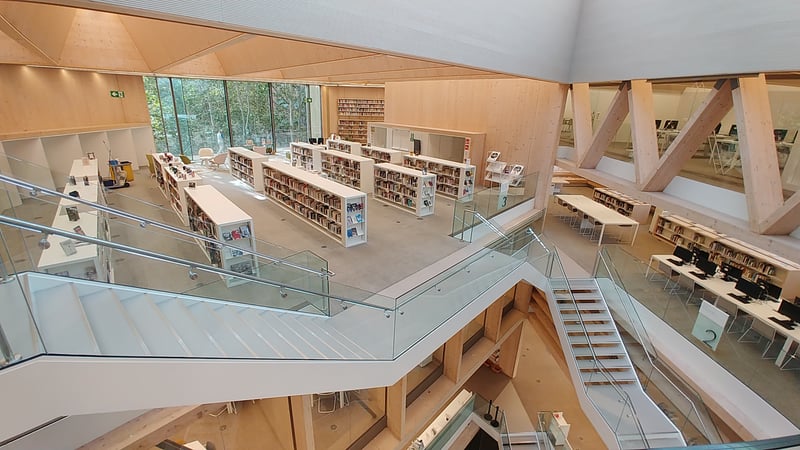
Standing out with their facilities, these spaces offer all the possibilities of modern technology to their users. Computer rooms, group study areas, quiet reading halls, and even terraces and cafeterias in some of them transform libraries into complete living spaces.
Biblioteca Jaume Fuster (Gràcia)
Located in the heart of Gràcia, Biblioteca Jaume Fuster is a building that stands out with its modern architecture. Opened in 2005, the library has a huge area of 5,636 square meters. My favorite feature is that it takes maximum advantage of natural light thanks to its large windows.
The study area on the upper floor of the library is truly magnificent. You can work from here while looking out over the rooftops of Gràcia. It seats around 300 people and almost every table has an electrical outlet. It is also a great advantage that it is open from 09:30 to 20:30 on weekdays.
Address: Pl. de Lesseps, 20, Gràcia, 08023 Barcelona
Working Hours:
Monday – Friday: 09:30 – 20:30
Saturday: 10:00 – 20:00
Sunday: 10:00 – 14:00
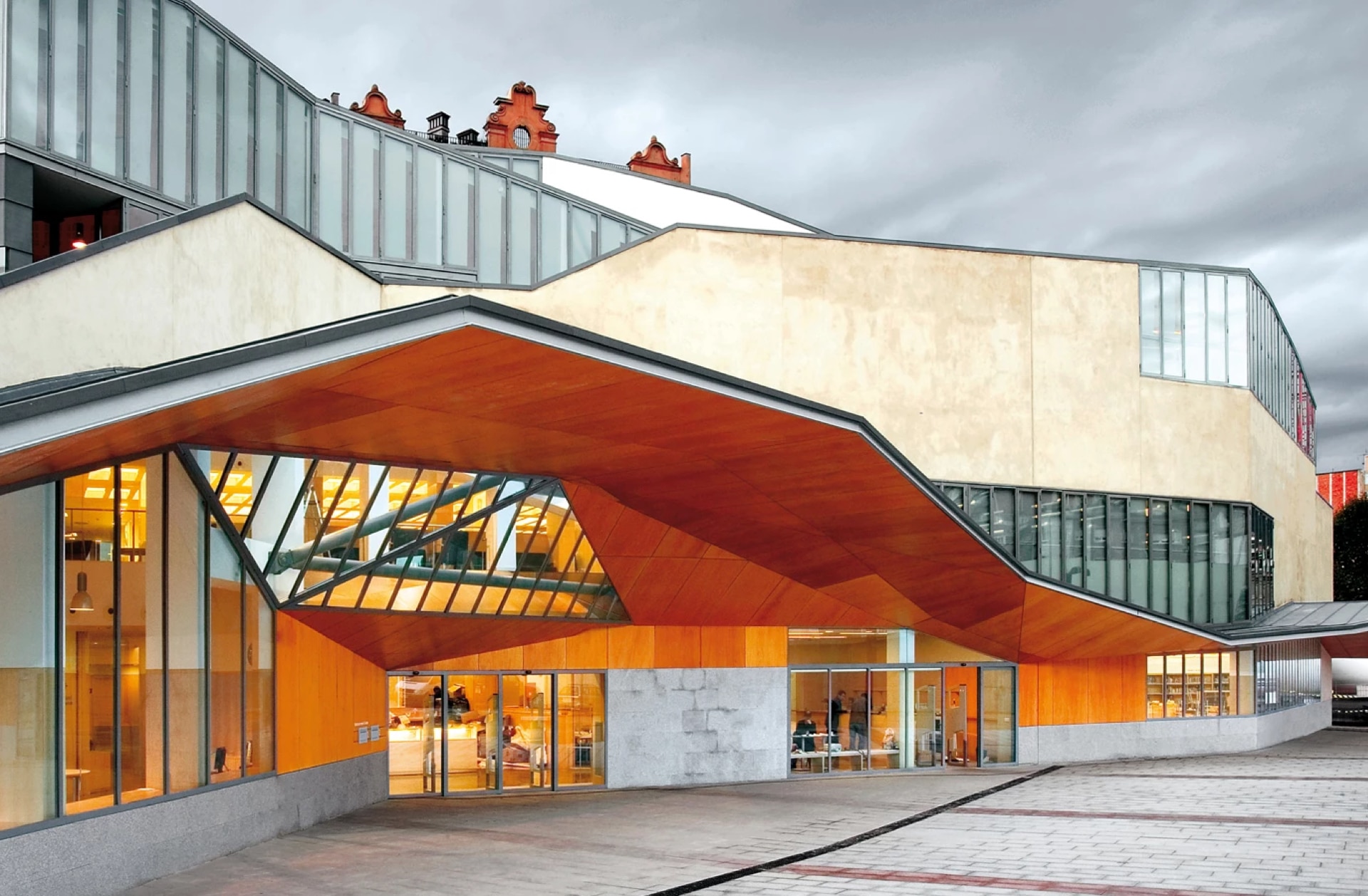
Biblioteca Gabriel García Márquez (Sant Martí)
Opened in 2022, the Gabriel García Márquez library stands out with its 3,000 square meter area, maker space section and digital facilities. It is one of the newest cultural centers in Barcelona with its special collection of Latin American literature and sustainable architecture.
Address: Plaça Carmen Balcells Segalà, 1, 08020 Barcelona
Working Hours:
Monday: 09:30 – 20:30
Tuesday: 09:30 – 20:30
Wednesday: 09:30 – 20:30
Thursday: 09:30 – 20:30
Friday: 09:30 – 20:30
Saturday: 10:00 – 20:00
Sunday: 10:00 – 14:00
Biblioteca Sagrada Familia
This library, just a 5-minute walk from La Sagrada Familia, dazzles especially with its architecture. It stands out with its modern design and spacious study areas. The terrace on the top floor of the four-story building is ideal for taking breaks from studying.
What I like most about here is the spaces designed for different purposes. There are quiet study sections, group study rooms, and even music listening rooms available.
Address: Carrer de Provença, 480, L’Eixample, 08025 Barcelona
Working Hours:
Monday – Friday: 09:30 – 20:30
Saturday: 10:00 – 20:00
Sunday: 10:00 – 14:00
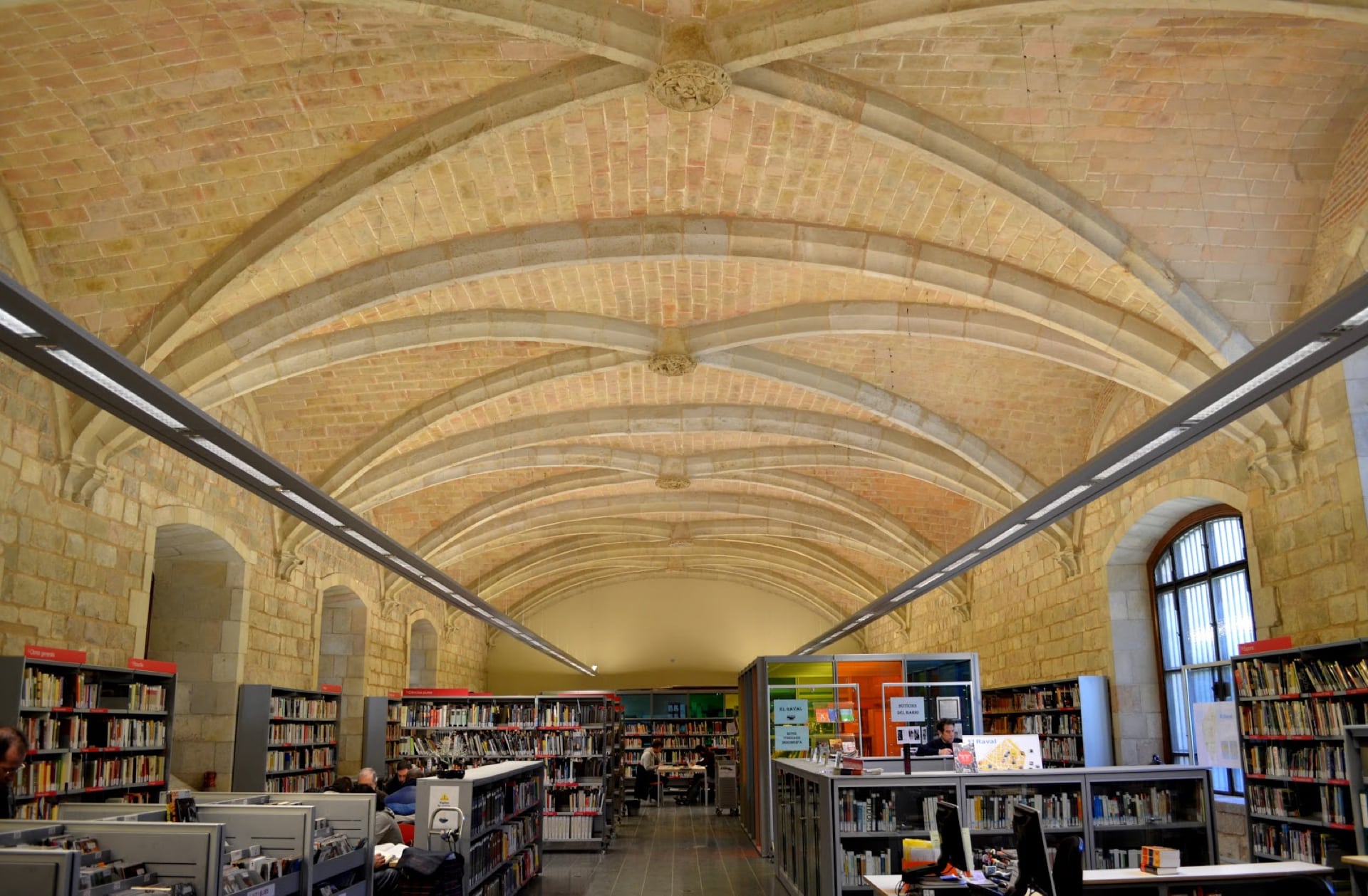
Biblioteca Sant Pau – Santa Creu (Raval)
Sant Pau – Santa Creu, Barcelona’s oldest library, has been serving since 1940. Located in the heart of Raval, this historic building takes you on a journey through time with its Gothic architecture. Converted from an old hospital building, the library is famous for its characteristic courtyard.
Although it doesn’t have as extensive study areas as other modern libraries, it offers a beautiful environment for those who want to work in a historic atmosphere. It has seating capacity for about 100 people, and working at the tables in the courtyard is one of my favorite activities.
Address: Carrer del Carme, 47, Ciutat Vella, 08001 Barcelona
Working Hours:
Monday: 15:00 – 20:00
Tuesday: 09:30 – 20:00
Wednesday: 15:00 – 20:00
Thursday: 09:30 – 20:00
Friday: 09:30 – 20:00
Saturday: 10:00 – 14:00
Sunday: Closed
Biblioteca Fort Pienc (Eixample)
Fort Pienc, located in the center of the Eixample district, stands out with its modern and functional design. It’s one of the best-equipped libraries, especially in terms of computer and internet services. It has more than 20 computer stations and fast wifi connection.
The library is quite generous in terms of study areas, with seating capacity for about 200 people. For me, its biggest advantage is its central location and ease of access. Being within walking distance of Arc de Triomf metro station is a great plus.
Address: Plaça Fort Pienc, 4, L’Eixample, 08013 Barcelona
Working Hours:
Monday: 15:30 – 20:00
Tuesday: 09:30 – 20:00
Wednesday: 15:30 – 20:00
Thursday: 09:30 – 20:00
Friday: 09:30 – 20:00
Saturday: 10:00 – 14:00
Sunday: Closed
Working Areas and Hours
Although each library has different working hours, they are generally open between 10:00 in the morning and 20:00 in the evening. Some larger libraries are open on Saturdays, and some libraries can stay open until midnight, especially during exam periods.
Cultural Events and Activities
The library card is not only a ticket to borrow books, but also to attend cultural events. Most of these events are free for cardholders.
- Language exchange groups
- Reading clubs
- Workshops for children
- Author talks
- Film screenings
Practical Tips and Suggestions for Libraries
I have a few suggestions for getting the maximum benefit from your library card. First, I recommend downloading the BibliosBCN app. With this app, you can track materials you’ve borrowed, extend your lending period, and see how busy libraries are.
If you want to use the study areas, I recommend choosing morning hours because it can get quite crowded in the afternoon. Some libraries also have group study rooms available, but these need to be reserved in advance.
Finally, if you lose your library card, report it immediately to the nearest branch – you can get a new one for a small fee.